Google signs 3.6 GW power deal with Constellation, including 890 MW of new nuclear capacity
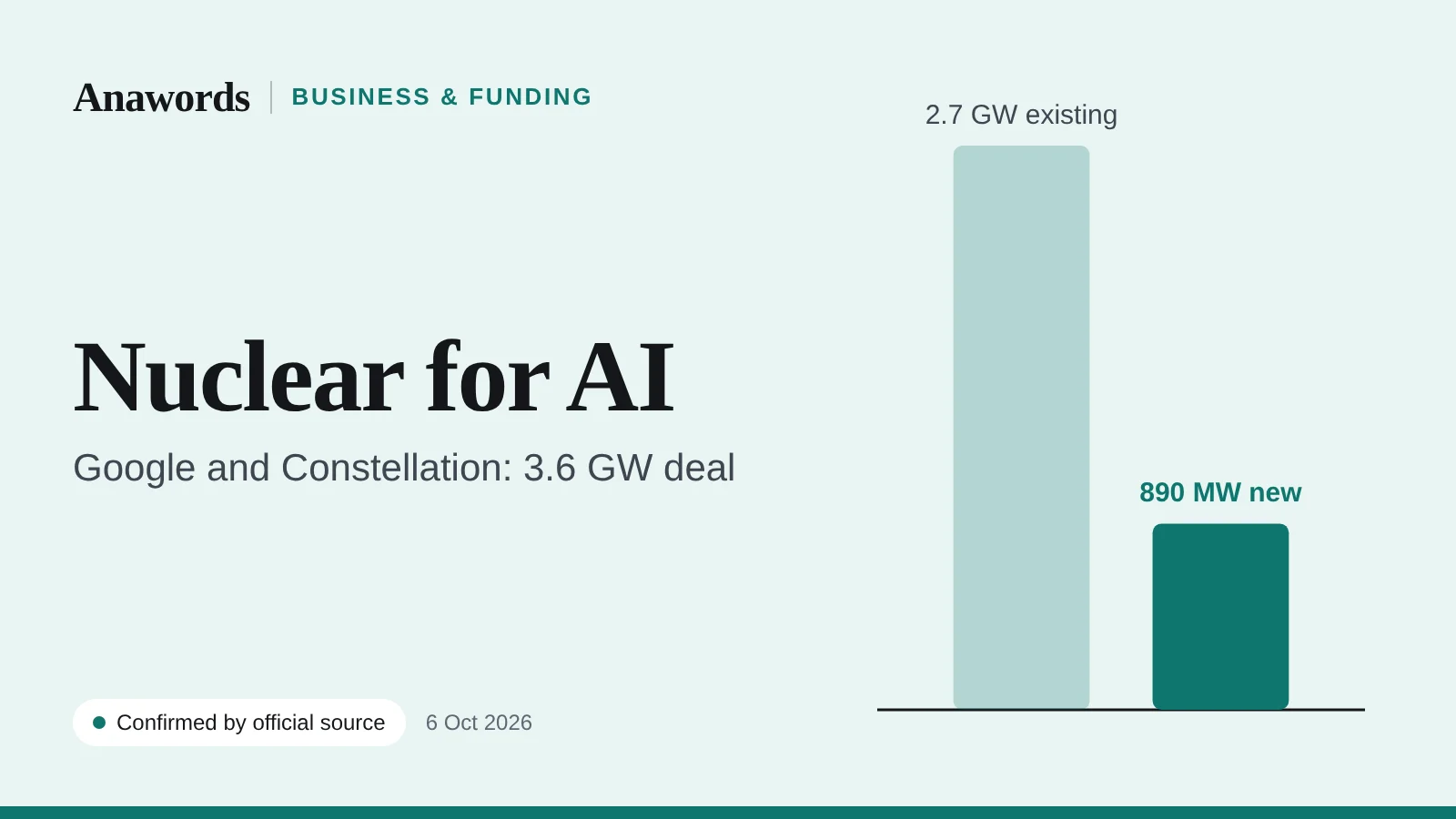
A 20-year agreement backs more than $4.3 billion of upgrades at 11 nuclear units in the PJM grid region, with the first due by 2028. A second 15-year deal covers 2.7 GW from existing plants.
How this story was checked
- ResearchedWith AI assistance · 3 sources
- AI source checkEach sentence matched to its source
- Editor approvalMayank Sahu · 11 Oct, 20:29
- Published11 Oct, 20:29
In short
Google and Constellation Energy announced on 6 October 2026 a 20-year agreement for 890 MW of new nuclear capacity from upgrades at 11 units in Illinois, Pennsylvania and New Jersey, plus a 15-year deal for 2.7 GW from existing plants in the PJM grid.
The deal
Google and Constellation Energy announced on 6 October 2026 two agreements covering about 3.6 GW of power in the PJM grid region of the eastern United States.13
- 890 MW of new capacity: a 20-year power purchase agreement linked to more than $4.3 billion of new investment by Constellation in upgrades, called uprates, at 11 nuclear units across six sites in Illinois, Pennsylvania and New Jersey.1 Constellation expects the first uprate by 2028.1 POWER Magazine reports the full amount is planned by the end of 2032.2
- 2.7 GW from existing plants: a separate 15-year energy supply agreement for 2,700 MW from Constellation’s existing PJM fleet. This adds no new capacity.12
What an uprate is
An uprate increases how much electricity an existing reactor produces, by modernising equipment such as turbines, steam generators and control systems.2 Constellation says the 890 MW is roughly the output of one large conventional reactor or several small modular reactors.1
More in the agreement
Constellation says the companies also expanded a five-year technology alliance built on Google Cloud and Gemini Enterprise, and will look at new clean generation, storage and demand-response projects, starting with PJM.1 Google also agreed to cut non-critical power use during high-stress grid events.1
Constellation says the work will support about 4,400 existing jobs and create about 7,200 construction jobs.1
Approvals still needed
Uprates need approval from the US Nuclear Regulatory Commission. POWER Magazine reports that Constellation expects to file a series of uprate applications from late 2026 to 2030.2
Why it matters for AI
Large tech companies are signing long power contracts to supply data centres that run AI. DCD notes earlier Google nuclear deals, including a planned restart of the Duane Arnold plant in Iowa with NextEra, and Constellation’s nuclear deals with Microsoft and Amazon.3
What is not known
The price Google will pay for the power, and the exact megawatts at each plant, were not disclosed in the sources we checked.
Fact ledger
How labels workQuestions readers ask
How much power is in the Google–Constellation deal?
About 3.6 GW in total: 890 MW of new nuclear capacity over 20 years and 2,700 MW from existing plants over 15 years.
When will the new nuclear power arrive?
Constellation expects the first uprate by 2028. POWER Magazine reports the full 890 MW is planned by the end of 2032.
Is a new reactor being built?
No. The new capacity comes from upgrading 11 existing reactors.