Sakana AI and UC Berkeley researchers publish MASS, a method for a model to train itself using its own multi-agent workflows
In MASS, one open model plays solver, workflow designer and judge, then is fine-tuned on its best results. The authors report gains on four research benchmarks but not on two coding benchmarks, and warn about shared blind spots.
How this story was checked
- ResearchedWith AI assistance · 3 sources
- AI source checkEach sentence matched to its source
- Editor approvalMayank Sahu · 12 Oct, 19:01
- Published12 Oct, 19:01
In short
Researchers from Sakana AI and UC Berkeley published MASS (Multi-Agent Self-Supervision), a method in which one language model designs, runs and judges multi-agent workflows and is then fine-tuned on the best results. With Qwen3.6-27B, the authors report 1.2–1.6 times better score per output token on four research benchmarks after two rounds.
What MASS is
MASS, short for Multi-Agent Self-Supervision, is described in a paper submitted to arXiv on 8 October 2026 by researchers from Sakana AI and UC Berkeley.2 Sakana AI published a project page on the work.1
In MASS, a single language model acts as the task solver, the optimiser that designs multi-agent workflows, and the evaluator that judges the results.1 An inner loop searches for a better workflow; an outer loop runs the best workflow many times, ranks the outputs and fine-tunes the model with LoRA on the top results. The updated model then repeats the process.1
What the authors report
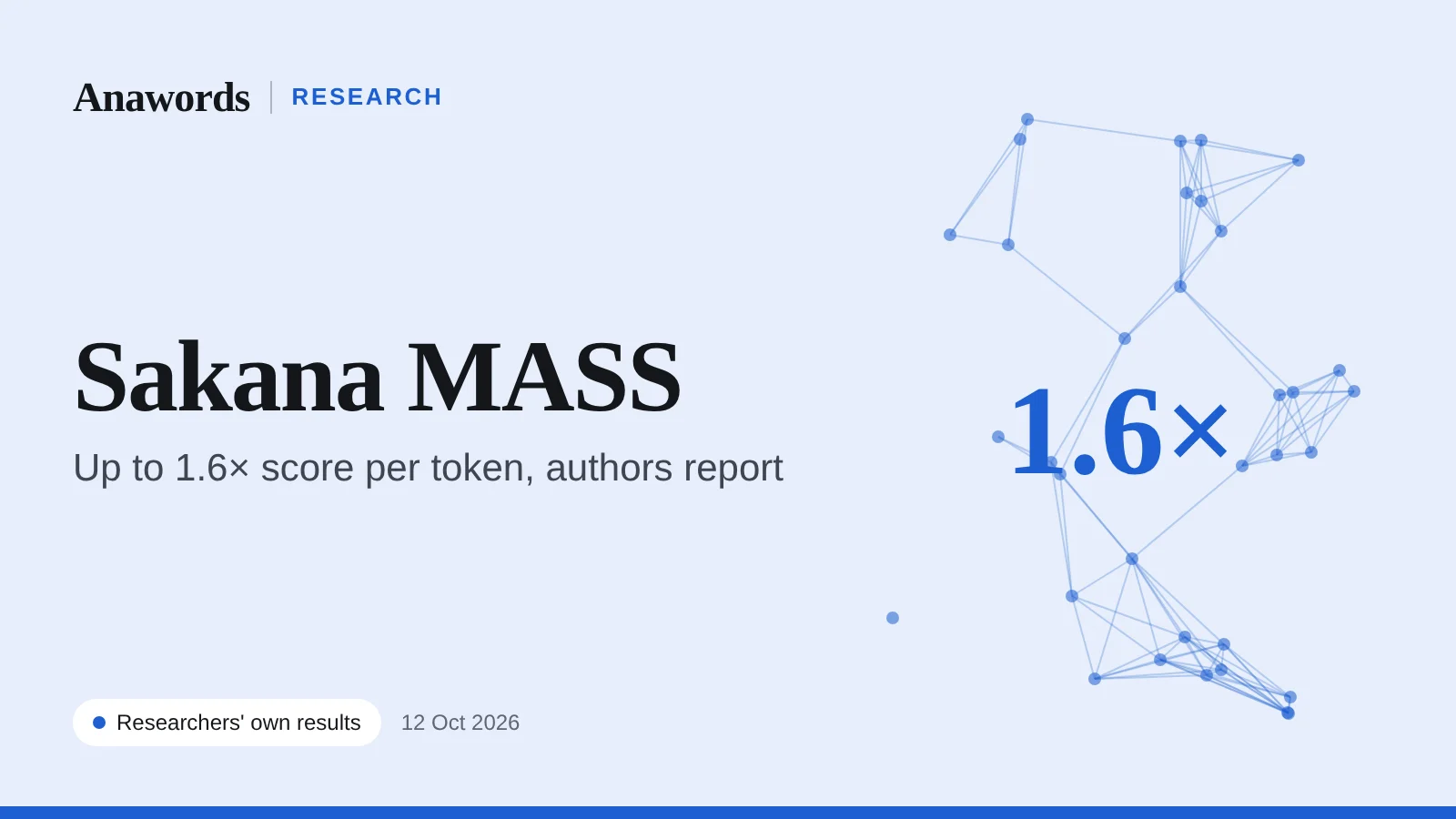
Using the open-weights Qwen3.6-27B model over two rounds, the authors report 1.2–1.6 times better score per output token on four open-ended research benchmarks.12 The project page gives 1.60x on MLR-Bench, 1.35x on DSBench, 1.28x on AstaBench E2E-Hard and 1.20x on ScienceAgentBench.1 On Terminal-Bench 2.0 and SWE-bench Verified the figures were 0.96x and 0.94x, below the base model.1
On held-out test tasks judged by GPT-5.5 and Claude Opus 4.8, the round-two model won 69.9% of comparisons against the base model.1 These are the researchers' own results.
Limits the authors state
The project page says "workflow search is noisy" and that "transfer remains uneven".1 AI Weekly noted the authors' warning that a shared blind spot in a loop where one model plays every role could let a flawed result be accepted as an improvement.3
Code is linked from the project page; it makes no statement about releasing model weights.1
Fact ledger
How labels workQuestions readers ask
What does MASS stand for?
Multi-Agent Self-Supervision.
Which model did they use?
Qwen3.6-27B, an open-weights model.
Did it improve everything?
No. The authors report gains on four research benchmarks but slightly lower scores on Terminal-Bench 2.0 and SWE-bench Verified.