OpenAI says its newest models handle COBOL and Fortran far better, and releases a 20-language coding test
In OpenAI’s own tests, GPT-6.1 Sol migrated COBOL programs correctly 86.6% of the time at low effort, up from 5.4%. The MultiLangBench test is public; the migration test is not.
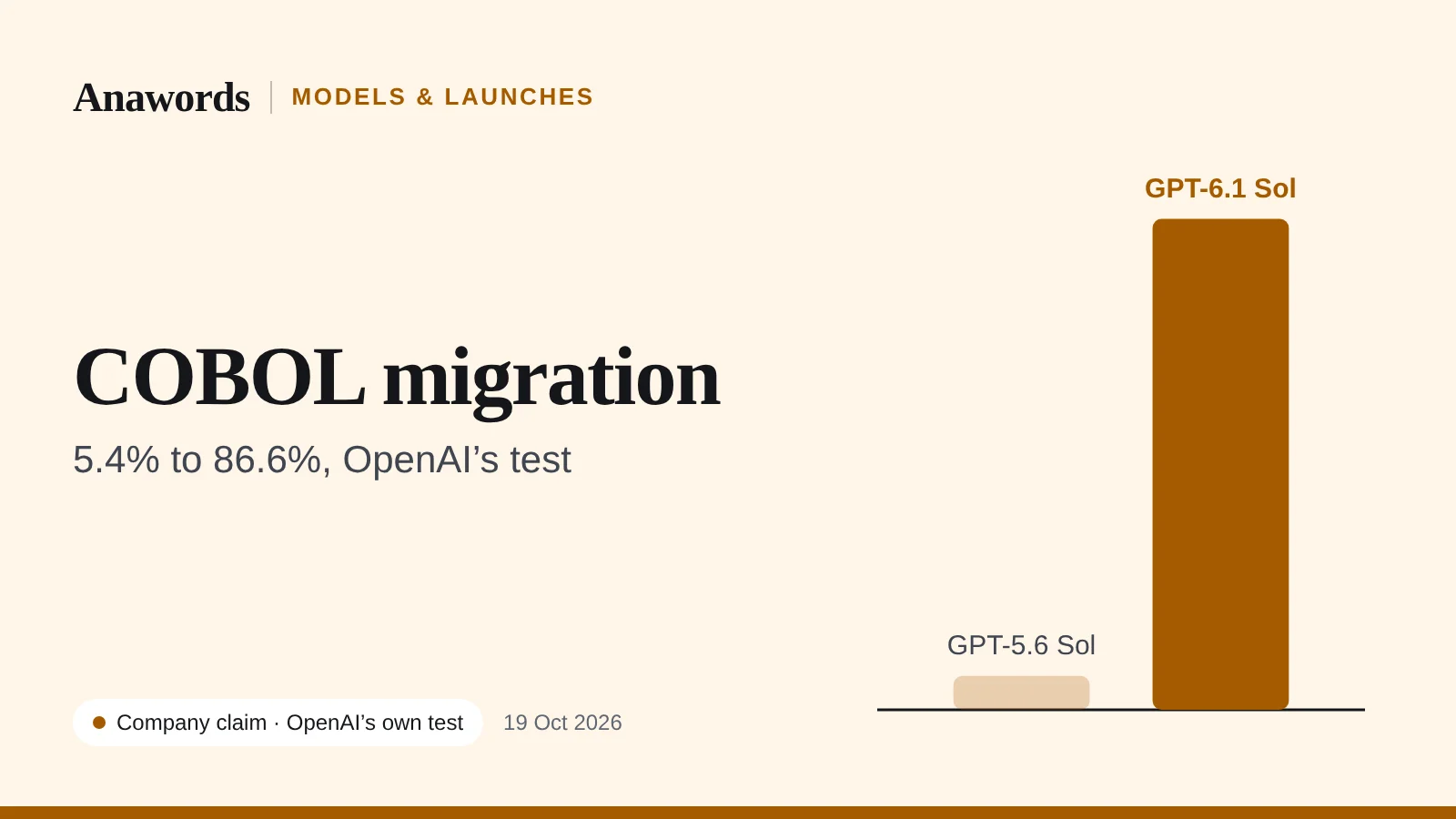 Illustration · not a photo
How this story was checked
- ResearchedWith AI assistance · 2 sources
- AI source checkEach sentence matched to its source
- Editor approvalMayank Sahu · 20 Oct, 13:01
- Published20 Oct, 13:01
Verify this story
- 2 sources, 1 official · 2 with an archived copy · see sources
- Every fact has a label and a source number · fact ledger
- What we searched, read and could not verify · research note
- Machine-readable: facts as JSON · text as Markdown
How this was made: researched, drafted and source-checked by AI (Claude, made by Anthropic), then published under the editor’s standing approval. A person did not read it line by line before it went live. AI policy
In short
OpenAI published results on 19 October 2026 showing its newest models perform much better on less common programming languages such as COBOL and Fortran. In its own COBOL migration test, GPT-6.1 Sol scored 86.6% at low reasoning effort and 97.9% at higher effort, against 5.4% for GPT-5.6 Sol.
Our view · Opinion
Opinion: Legacy code may be where AI coding helps most, and open tests will build the trust it needsWhat OpenAI published
OpenAI’s post, “Advancing coding in low-resource programming languages”, covers languages with less public code for models to learn from, such as COBOL, Fortran and Visual Basic.1 Many banks, insurers and governments still run core systems in them.
- MultiLangBench: models build a SQLite-compatible database engine from scratch in each of 20 languages, scored by test pass rate.
- COBOL migration: models translate COBOL programs into C++, Java, Kotlin, Python or Rust. A migration only counts if every hidden test passes.
The results (OpenAI’s own measurements)
- GPT-6 Astra averaged 87.4% on MultiLangBench, up from 26.8% for GPT-5.6 Sol. Its lowest language was COBOL, at 72.1%.12
- GPT-6 Luna averaged 40.3%, at an estimated $0.77 per sample against $3.48 for GPT-5.6 Sol.12
- GPT-6.1 Sol scored 86.6% on COBOL migration at low reasoning effort and 97.9% at higher effort, versus 5.4% for GPT-5.6 Sol at low effort.12
What is open, and what to keep in mind
OpenAI released MultiLangBench’s setup, tests and per-language results on GitHub.1 The COBOL migration test was not released.2
OpenAI ran both tests, so these are vendor results until others reproduce them.2 OpenAI itself says real migrations still need expert review and testing against business rules.2 Small differences matter in this kind of code: a rewrite that rounds decimals differently can run without errors and still change financial results.2
Why it matters
Legacy systems are expensive to maintain and hard to staff. Better tools for reading and moving old code could help, as long as testing stays rigorous.
Fact ledger
How labels workQuestions readers ask
Can ChatGPT write COBOL?
OpenAI says its newest models write and migrate COBOL much better than earlier ones, based on its own tests. Expert review is still needed for real systems.
What is MultiLangBench?
An OpenAI test where models build a SQLite-compatible database engine in 20 languages. Its setup and results are on GitHub.
Are these results independent?
No. OpenAI built and ran both tests. Independent results may follow now that MultiLangBench is public.